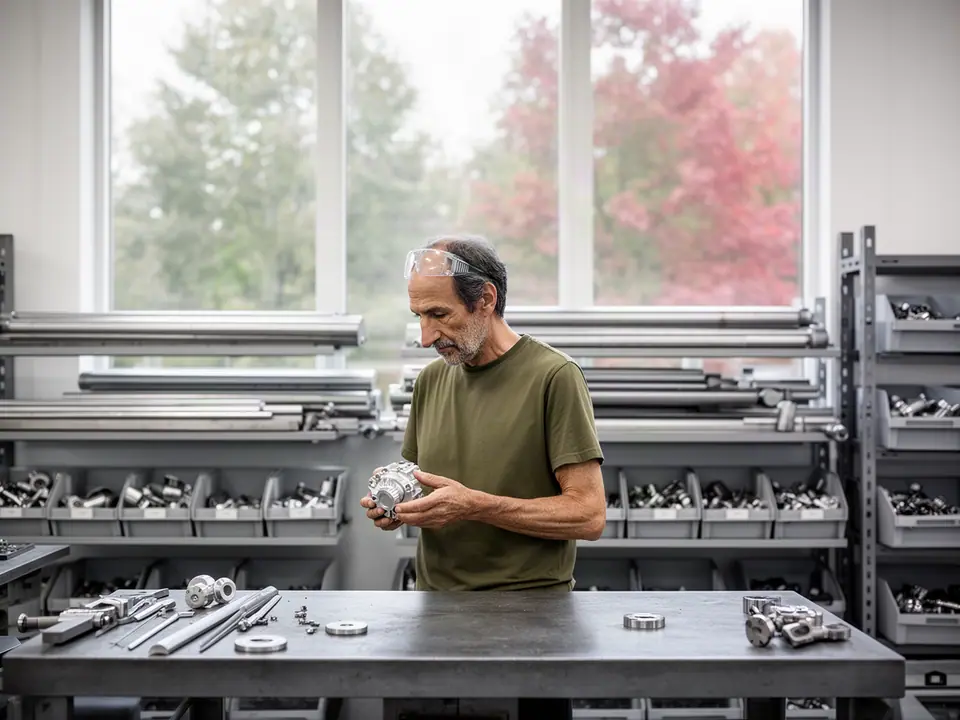
A Lake County, OH machine shop can pay for a CNC mill or a stamping press with an equipment loan secured by the machine, a lease, or a line draw for a deposit that comes due months before delivery. The worked cases that follow are invented and computed in code; the county counts come from the Census Bureau.
A builder's deposit can ride on a line until the mill ships; a fair market value lease costs less if the mill goes back, more if the shop buys it; a press secures its own loan; a trade-in lowers the amount.
Deposit at Order, Balance at Delivery: Carrying a CNC Mill Deposit Through a Long Lead Time
A new vertical machining center can be built to order, with a deposit due when the order is placed and the balance due at delivery. That splits one purchase into two financing questions. The deposit leaves the shop months before the machine earns anything, so a short line of credit draw can carry it; the full price can then go on an equipment loan when the mill arrives, with the mill as collateral.
Invented figures, for illustration: a $186,400 mill with a 20% deposit of $37,280 and a 16-week lead time. Drawn for those 112 days at 12.3%, the deposit costs $1,407.04 in interest. At delivery, if a partner finances the full price over 72 months at 9.9%, the shop pays $3,443.82 a month; the 72 payments total $247,955.04, $61,555.04 of it interest, and the loan proceeds clear the deposit draw. A partner may instead ask for money down.
Ask the builder in writing when the deposit is due, what happens to it if delivery slips, and whether the balance is due on shipment or after the mill passes its run-off test. Those dates set how long the draw stays out.
Fair Market Value Lease or a $1 Buyout on a Mill the Shop May Replace in Five Years
A lease is the other route, and the two common kinds end differently. A $1 buyout lease ends with the shop owning the mill for a dollar. A fair market value lease has lower payments, and at the end the shop can return the mill or buy it at a price set then. A shop that expects to want a newer control and more spindle speed in five years may care more about the exit than the payment.
| Lease | Monthly payment | Paid over 60 months | If the shop keeps the mill |
|---|---|---|---|
| $1 buyout | $3,610 | $216,600.00 | $216,601.00 with the $1 |
| Fair market value | $3,140 | $188,400.00 | $219,400.00 with a $31,000 purchase |
Compare the two invented quotes: if the mill goes back after year five, the fair market value lease has cost $28,201.00 less. If the shop decides to keep it at the invented $31,000 price, it ends up paying $2,799.00 more than under the $1 buyout. A loan set beside a $1 buyout lease for an air compressor is worked on the equipment financing page.
A Stamping Press That Secures Its Own Loan
A machinery loan is a loan to buy one machine, secured by that machine. A partner may file a lien on it, and the lien is released when the loan is paid off. Because a stamping press has a model, a tonnage rating, a serial number and a resale market, it can carry its own loan without tying up the rest of the shop.
For illustration only, with invented figures: a mechanical stamping press at $72,900 over five years at 10.05%. Sixty payments of $1,550.70 clear it, $93,042.00 in all, so the interest comes to $20,142.00. The die sets made for one customer's part are a separate question: they fit one job, have little resale value, and a partner may want them handled apart from the press.
A press that is a few years old can still serve as collateral; a partner may ask for an inspection or an appraisal and set the term by the age of the machine.
Trading In an Old Manual Mill to Shrink the Amount Financed on a New One
A shop moving from a manual knee mill to a smaller CNC mill can offer the old machine to the dealer as a trade-in. The dealer's credit comes off the price on the invoice, so the amount to finance shrinks before the request is written.
In this invented example, a $94,700 CNC mill with an $8,500 trade-in credit leaves $86,200. Over 48 months at 11.1%, the shop sends $2,232.07 a month and $20,939.36 of interest in total. Without the trade-in, financing the whole $94,700 on the same terms would mean $2,452.17 a month, $220.10 more each month and $2,064.80 more interest over the term.
For the request itself, have the dealer quote showing the trade-in line, the mill's spec sheet, recent business bank statements and a list of the work the mill will take on. A term loan can cover costs that come with the switch but are not part of the machine, such as programming software seats.
Crew Size at Lake County, OH Fabricated Metal Shops Against the County's Other Trades
Only 32.9% of the fabricated metal shops with paid staff in Lake County, OH had fewer than five employees in 2023, against 51.0% across every sector in the county (County Business Patterns), so this is a trade of shops with real crews. Owners who work alone are counted separately: Nonemployer Statistics found 66 fabricated metal businesses with no paid employees in the county in 2024, with $5,541,000 in receipts.
ZIP Code Business Patterns placed 21 fabricated metal employer establishments at ZIP 44077 addresses in 2023. County-wide, the group (NAICS 332, which includes machine shops) had 228 employer establishments, 75 of them under five employees, with 5,411 employees and an annual payroll of $333,401,000. The manufacturing equipment financing page covers inspection gear, saws and material orders; the rest of the worked cases are under all articles.
By Laurelbridge Business Capital · Updated